
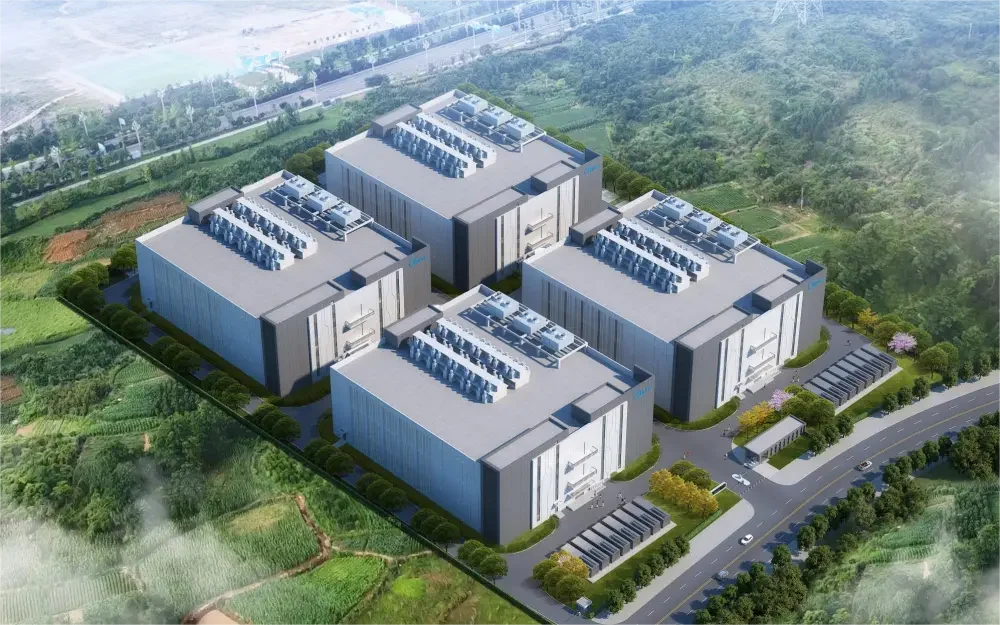
China’s computing infrastructure strategy offers a useful perspective on power-aware site selection, high-density facility design and energy efficiency. The lessons are practical, but not every approach travels easily across markets.
The difficult part of building an AI data center is no longer confined to installing servers.
A developer may have customers, financing and a site, yet still face years of work securing electricity, connecting to the grid, designing cooling systems and preparing the facility for successive generations of computing hardware.
These challenges are familiar across the global industry. China is approaching several of them through a combination of regional infrastructure planning, engineering standards and data center efficiency programs.
Its experience is worth examining, particularly for developers working on large AI campuses.
But there is an important distinction between learning from China's infrastructure practices and assuming that its development model can be reproduced elsewhere.
China's electricity markets, planning arrangements, geography and industrial supply chains are different from those in Europe, North America and much of Southeast Asia.
The more useful question is which engineering and planning principles remain relevant once those differences are taken into account.
Power availability is changing the geography of computing
China began implementing its East Data, West Computing initiative in 2022, establishing eight national computing hubs and ten data center clusters.
The initiative responds to a geographic imbalance. Much of China's digital demand is concentrated in eastern economic centers, while parts of the country's western and northern regions offer greater access to land and energy resources.
The objective is to distribute suitable computing workloads more effectively across regions, supported by data center infrastructure and network connectivity.
For AI infrastructure developers, the underlying issue is familiar.
A location close to customers may not offer the most practical route to securing a large electricity supply. A site with better energy resources may introduce additional network costs, operational challenges or distance from users.
China's approach makes that trade-off part of regional infrastructure planning rather than leaving it entirely to individual project decisions.
The distinction between workloads matters.
Applications requiring low latency or close integration with customers may need to remain near major demand centers. Some large training workloads, by contrast, may allow greater flexibility in physical location, provided network capacity, data movement and operating requirements can be met.
There is no universal advantage to building farther from customers.
What matters is matching the workload to the location, rather than treating every new data center as if it had identical requirements.
For international developers, China's national computing-hub program is therefore most useful as a planning reference. It demonstrates an approach to coordinating regional energy resources, computing demand and network infrastructure.
Whether that approach delivers better economics must still be established at the project level.
High-density AI infrastructure is changing facility engineering
The engineering requirements of an AI data center can differ substantially from those of a conventional enterprise computing facility.
High-density racks place greater demands on electrical distribution, cooling, network cabling, equipment access and maintenance.
Those requirements affect the building itself.
A facility designed around traditional server configurations may need extensive modifications to accommodate newer AI systems. Changes can involve floor loading, pipework, overhead routing, equipment clearances and the placement of cooling infrastructure.
China's equipment-efficiency and green computing initiatives increasingly address these systems together.
At a March 2026 briefing, China's Ministry of Industry and Information Technology (MIIT) identified cooling, power supply and distribution, system integration and intelligent operations as important areas for improving computing infrastructure efficiency.
The ministry highlighted technologies including hybrid liquid cooling and integrated power modules. It also referred to standards work covering cold-plate liquid cooling and single-phase immersion cooling.
These are policy and technical-development priorities. They should not be interpreted as evidence that every Chinese AI data center has adopted the technologies or that all implementations deliver the same performance.
Their relevance lies in the engineering approach.
As rack power densities rise, decisions about cooling and electrical architecture become closely connected to the computing equipment selected.
A change in accelerator configuration can affect coolant requirements, power distribution, equipment layout and maintenance procedures.
Developers that make these decisions independently may face expensive redesigns later.
The practical lesson is to involve computing-hardware suppliers, electrical engineers, cooling specialists and facility operators early enough for their requirements to shape the design together.
That principle applies regardless of whether a project uses Chinese, American or other equipment suppliers.
China's efficiency figures need to be read carefully
China has also developed a national program to identify and promote more energy-efficient computing facilities.
In March 2026, MIIT reported that 306 facilities had been recognized under the national green computing facility program, with an average Power Usage Effectiveness (PUE) of 1.25.
The figure is useful, but it requires context.
These are facilities recognized through a specific national program. They are not a representative sample of all Chinese data centers, nor are they exclusively AI facilities.
The reported average should therefore not be presented as China's national AI data center PUE.
PUE itself has limits.
It measures total facility energy consumption relative to IT equipment energy consumption. It does not establish how efficiently a GPU cluster performs useful work, how much computing capacity is utilized or the carbon intensity of the electricity consumed.
A low-PUE facility can still have poorly utilized computing equipment.
Conversely, a facility operating under more demanding cooling conditions may have a higher PUE while delivering valuable computing services efficiently.
These distinctions are increasingly important as operators compare infrastructure performance across countries.
Climate, cooling architecture, workload characteristics and operating conditions can all affect the numbers.
For international developers, the lesson is to treat PUE as one part of an operating assessment, rather than a standalone measure of data center quality.
From efficient buildings to useful computing capacity
China's September 2026 update to its national green computing facility evaluation framework provides another perspective.
The revised framework covers four broad areas: energy utilization, carbon management, water-resource utilization and computing-resource utilization.
It introduces or strengthens attention to indicators such as energy efficiency per unit of computing capacity, carbon utilization efficiency, digital carbon management and product carbon footprints.
The evaluation also gives greater weight to selected measures, including renewable-electricity use, water efficiency and rack occupancy.
The program is a recommendation and evaluation mechanism for eligible facilities, with provisions for ongoing assessment. It is not a blanket rule requiring every Chinese data center to meet the same criteria.
Still, the framework reflects a meaningful change in what infrastructure performance is expected to capture.
A data center is not necessarily performing well simply because the building uses relatively little overhead energy.
Its computing equipment also needs to be put to productive use.
That distinction matters commercially.
Developers can construct a technically efficient facility, but the economic outcome will depend on customer demand, equipment utilization, electricity costs and the reliability of the computing service delivered.
The evaluation framework does not solve these commercial questions. Nor does rack occupancy directly measure GPU utilization or useful AI output.
But bringing energy, carbon, water and resource utilization into the same assessment is a more comprehensive approach than relying on PUE alone.
For operators in other markets, it raises a useful question: are infrastructure performance indicators keeping pace with the economics and operating requirements of AI computing?
Renewable energy and reliable power remain separate challenges
China's computing-hub strategy also places considerable emphasis on aligning data center development with regional renewable-energy resources.
That creates opportunities, particularly where renewable generation, land and supporting infrastructure can be developed together.
But renewable-energy availability is not the same as a guaranteed electricity supply for a data center.
Large AI facilities require reliable power. Renewable generation varies by technology, location and time, while the facility's computing load may have its own operating profile.
The challenge is therefore broader than securing an annual volume of renewable electricity.
It includes grid capacity, transmission infrastructure, firm supply arrangements, backup systems and, where technically and commercially feasible, demand flexibility.
China's 2026 green computing facility recommendation requirements reflect some of these considerations.
The policy calls for renewable electricity consumption to meet applicable regional requirements and encourages coordination between new computing facilities and renewable generation, supported by reliable power and flexible operating capabilities.
These provisions do not demonstrate that the resulting facilities operate entirely on renewable electricity every hour.
They do show that electricity sourcing and power-system requirements are being considered within the same policy framework.
For developers outside China, this is an area where careful comparison is especially important.
The economics of renewable procurement, grid access and backup supply differ widely across electricity markets.
An arrangement that works under one country's market rules may not be available, or commercially attractive, elsewhere.
What can actually be transferred?
China's experience is most relevant where it offers a way to improve coordination between decisions that are often made separately.
Regional site selection can take account of electricity availability and workload requirements.
Facility engineering can be developed around the expected computing architecture rather than a generic building specification.
Cooling, electrical distribution and equipment integration can be considered as one design problem.
Operational assessment can incorporate computing-resource utilization alongside energy, water and carbon indicators.
None of these practices is unique to China.
What distinguishes China's approach is the effort to connect them through national computing-hub planning, technical standards and facility evaluation programs.
That does not remove the risks of overbuilding, underutilized equipment or projects whose power and network requirements prove more difficult than expected.
It also does not establish that Chinese projects are universally faster, cheaper or more efficient than comparable projects overseas. Such claims would require consistent project-level data on costs, construction schedules, operating performance and reliability.
For global developers, the value lies in examining the methods rather than assuming the outcomes.
A power-rich location is useful only if the workload can operate there economically.
A high-density facility design is valuable only if it supports the hardware, maintenance requirements and upgrade cycles of its customers.
An efficient building delivers its full value only when the computing equipment inside it is being used productively.
China's data center buildout offers a large and evolving set of infrastructure practices to study.
The most transferable lesson may be that the economics of AI computing depend on decisions made well before the first accelerator is installed — particularly decisions about power, location, cooling and the ability to operate the facility over time.
For an industry facing increasingly large power requirements and long infrastructure lead times, those decisions deserve as much scrutiny as the computing hardware itself.
Sources
- NDRC — East Data, West Computing official Q&A — 2022-02-17.
- MIIT — Energy-efficient equipment implementation plan press briefing — 2026-03-20.
- MIIT and four departments — 2026 green computing facility recommendation notice — 21 September 2026 (document dated 8 September 2026).
- MIIT-hosted expert explanation — evaluation framework — 2026-09-23.